

Most media consoles stand about 610 to 813 mm tall, and 610 to 762 mm is the range that suits most living rooms. But the average is only a starting point. The number that really matters is where the centre of your TV screen lands compared with your eyes when you are seated. If you are shopping for a media console, this guide shows how to convert that eye-level target into the console height, width and spacing that suit your room.
Table of Contents
What "Average" Hides
Retail and design guides put the typical TV stand at roughly 610 to 813 mm tall, and many narrow the sweet spot to 610 to 762 mm. Low-profile and floating consoles sit below that range, while cabinet-style pieces and entertainment centres can rise above it. The spread exists for a reason: the right height depends on three variables.
- TV size. A bigger screen is taller, so its centre sits higher above the console top. A taller screen calls for a lower console.
- Your seated eye level. Guides commonly cite 1016 to 1067 mm from the floor for an adult on a standard sofa, though a deep, low sofa or recliner can put your eyes lower.
- How the TV is installed. A TV that sits on the console, or one mounted on the wall above it, changes the math.
Use the average to filter your options, then use the formula below to confirm the fit.
The Eye-Level Formula
The guidance is consistent across the furniture retailers that publish it: the centre of the screen should sit at or just below your seated eye level. That gives a calm, neutral head position and avoids neck strain. To find the console height, follow four steps:
- Measure your seated eye level. Sit on your main sofa in your normal viewing posture, and have someone measure from the floor to your eyes. Most people land between 1016 and 1067 mm.
- Find your TV's screen height. For a standard 16:9 screen, the height is about 49 per cent of the diagonal size. A 1651 mm TV is roughly 813 mm tall.
- Divide the screen height by two. That is the distance from the bottom of the screen to its centre.
- Subtract. Eye level minus half the screen height gives the ideal height of the console top.
For example, with a 1067 mm eye level and a 1651 mm TV (about 813 mm tall), half the screen is 406 mm, so the console top should be about 660 mm high.
Console Height by TV Size
The table below applies the formula to common screen sizes for the two eye levels most guides use. Screen heights are calculated from standard 16:9 proportions, so they are close approximations.
TV size | Approx. screen height | Console height at 1016 mm eye level | Console height at 1067 mm eye level |
1092 mm | 533 mm | about 749 mm | about 800 mm |
1397 mm | 686 mm | about 673 mm | about 724 mm |
1651 mm | 813 mm | about 610 mm | about 660 mm |
1905 mm | 940 mm | about 546 mm | about 597 mm |
2159 mm | 1067 mm | about 483 mm | about 533 mm |
Two notes for reading the table. First, the formula treats the bottom of the screen as sitting right on the console top. Most TVs add 25 or 51 mm from their feet and bezel, so you can go that much lower. Second, if your sofa is very low or you watch while reclining, measure your actual eye level and rerun the numbers.
This is why a console that looks fine on its own can be wrong for a big TV. A 1905 mm screen on a 762 mm console puts the centre of the picture well above most people's eyes.
Console Width and Spacing
Height is only one dimension. Width and viewing distance complete the setup.
Width. A common guideline is for the console to extend a few millimetres past the TV on each side. A balanced look is usually 76 to 152 mm per side, or a bit more. Using standard 16:9 widths, that works out to:
TV size | Approx. TV width | Suggested console width |
1092 mm | 953 mm | 1118 to 1270 mm |
1397 mm | 1219 mm | 1372 to 1524 mm |
1651 mm | 1448 mm | 1600 to 1753 mm |
1905 mm | 1651 mm | 1803 to 1956 mm |
2159 mm | 1880 mm | 2032 to 2184 mm |
If you plan to add a soundbar, speakers or decor to the sides, go wider.
Viewing distance. Retail guides typically recommend sitting about 1.5 to 2.5 times the diagonal of the screen away. For a 1651 mm TV, that is roughly 2.4 to 4.0 metres. Height and distance work together: when the sofa moves closer or farther, the comfortable angle changes slightly.
Plan for the Next TV, Not Just the Current One
Screens tend to get bigger with each upgrade, and a console is a long-term purchase. If you expect to move up a size in the next few years, run the formula for both screens. A console that works for a 1397 mm TV at 711 mm may sit too high for a 1905 mm model, as the table above shows. In that case, choose a height in the middle, or pair a lower console with a wall mount or tilting bracket that lets you fine-tune the screen position. Width is easier to future-proof: buying a console sized for the larger TV costs little extra and looks balanced with the smaller one in the meantime.
If You Plan to Wall-Mount the TV Above the Console
Mounting changes the sequence. You choose the mount height first, using the same eye-level rule, and then the console has to sit below it with a clean gap. Guides from furniture makers commonly recommend leaving about 102 to 203 mm between the console top and the bottom of the TV. That is enough room for a soundbar and keeps the screen from looking like it is floating or sitting on the furniture. If the console is too tall for that gap, the TV ends up above eye level, which is the most common mounting mistake.
Look at the Listed Height, Not Just the Width
Product pages usually lead with width, such as 2007 mm, but height and depth appear in the dimensions chart. Check them against your calculation before you buy.
The 2007 mm glass door walnut TV stand is a good example of a console where the details matter. Its listing describes a flip-down glass front, ambient LED lighting, raised edges to keep contents secure and pre-drilled cable holes.
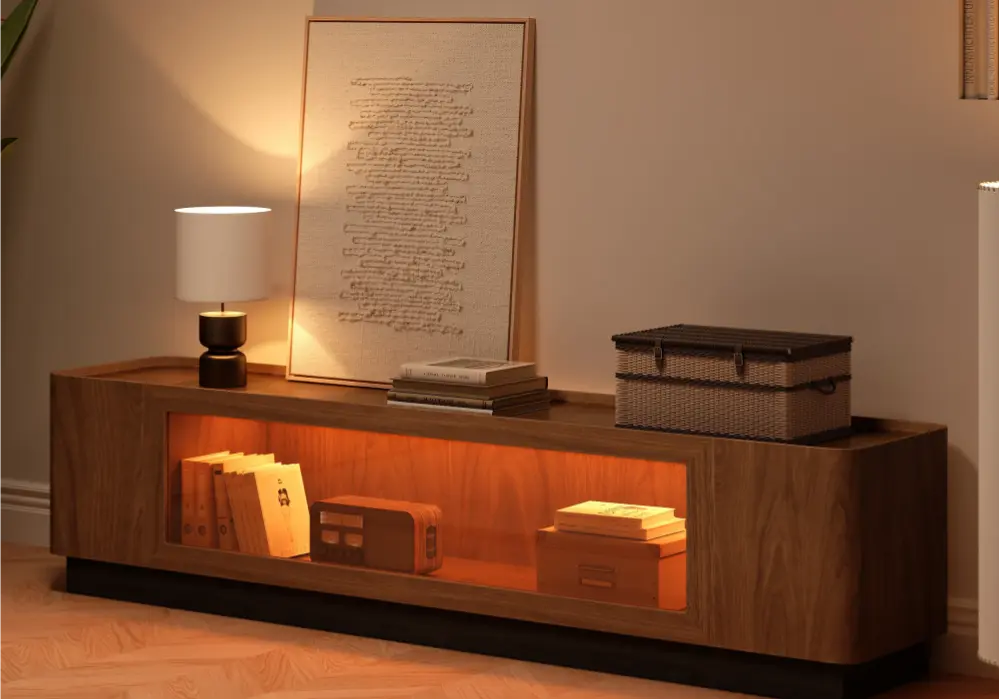
A console with a glass front is also a display piece, so its height affects what guests see as well as where the screen sits. Compare the listed height with your formula result, and check how much of the top is free for TV feet.
If your room is large or you plan to upgrade to a bigger screen, an adjustable-length design can help. The extendable floor TV stand is described as a contemporary media console with an extendable feature, adjustable in length to fit larger TVs and different living room layouts.
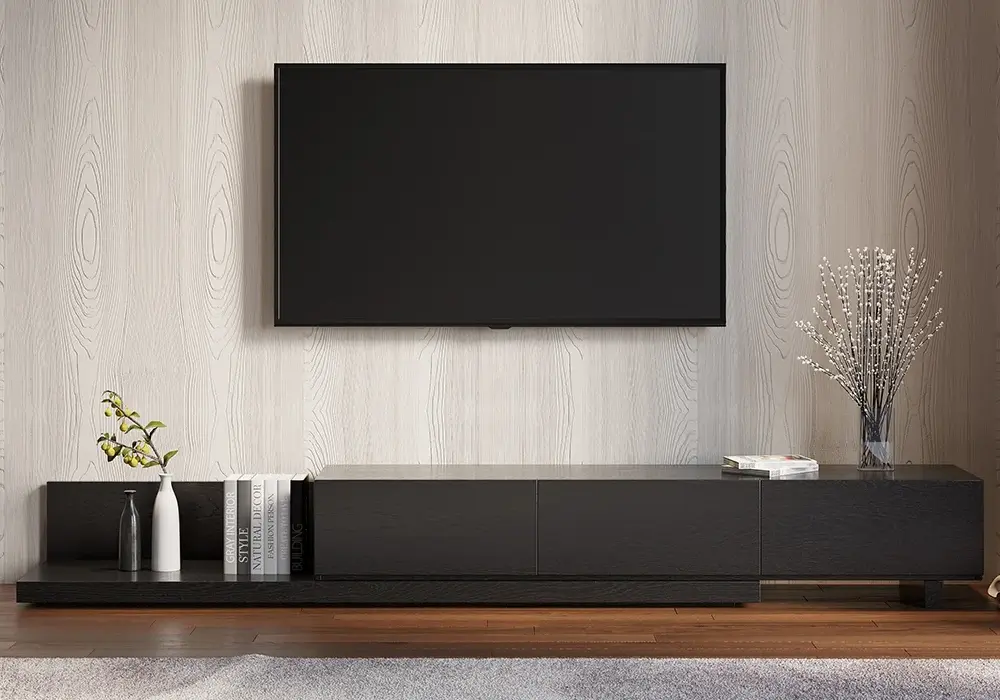
For an extendable model, check the height spec for both the retracted and extended positions, because the length changes but the height usually does not. Then confirm that the width range suits both your current TV and a future upgrade.
Special Situations
- Low sofas, floor seating or recliners. Measure your actual seated eye level. In a reclined position your eyes are lower, which favours a lower console or a TV mounted lower on the wall.
- Bedrooms. If you watch lying down or propped on pillows, your eye level is often higher or at a different angle. Measure from your usual spot, and consider a taller console, or one paired with a swivel mount.
- Multiple seating areas. Prioritise the main seat, or compromise on a height that works for both. An in-between height with a tilting or swivel mount helps.
- Soundbars. A soundbar placed in front of the TV raises or blocks part of the screen. Leave room below the bottom of the screen, or mount the soundbar under it.
Common Mistakes
- Buying by width alone. A console that is wide enough can still be 102 to 203 mm too tall for the TV.
- Ignoring the TV's feet. Check the foot spacing and the console top depth, so the TV sits stable.
- Forgetting ventilation and cables. Devices need airflow, and cable holes should line up with your outlets.
- Measuring standing eye level. The number that counts is seated, not standing.
Frequently Asked Questions
What is the standard height of a media console?
Most run about 610 to 813 mm tall, and many retailers describe 610 to 762 mm as the most common range. Low-profile and floating designs go lower.
How high should a TV stand be for a 1651 mm TV?
With a seated eye level of 1016 to 1067 mm, the formula gives a console top of about 610 to 660 mm. You can go 25 or 51 mm lower to allow for the TV's feet and bezel.
Should the TV be at eye level?
Guides generally recommend the centre of the screen at or slightly below seated eye level. Setting it above eye level is a frequent cause of neck strain.
How far should a media console be from the sofa?
Plan on a viewing distance of roughly 1.5 to 2.5 times the diagonal of the TV. For a 1397 mm screen, that is about 2.1 to 3.4 metres.
How wide should a media console be compared with the TV?
Aim for 76 to 152 mm of extra width on each side. For a 1651 mm TV, a console between about 1600 and 1753 mm wide looks balanced.
How much space should be between a wall-mounted TV and the console?
Many guides suggest 102 to 203 mm between the console top and the bottom of the screen, enough for a soundbar and a comfortable look.