

Ask ten people how high a coffee table should be and most will say "about 16 to 18 inches." That number is a handy shopping convention, but it is not a furniture standard, and it will not tell you whether a table feels right in front of your sofa. A table that matches the textbook height can still leave you perched on the cushion edge, stretching for a drink.
Below, you'll find how to measure your sofa, match height to how you use the table, and test it in five minutes before ordering. When you're ready to compare, browse our coffee tables, and see the 14-, 17-, and 19-inch examples that show how each height works in practice.
In This Guide
Use the standard range as a reference
The 16–18-inch range gives you a place to begin comparing products. It does not tell you whether a particular table will feel comfortable in front of your sofa. Seat cushions, seat depth, your preferred sitting position, and the gap between the furniture all affect the reach.
Measure the top of your seat cushion, then sit normally and test a temporary surface at the proposed table height. Avoid changing your posture to make the candidate work. If you have to perch at the edge or bend farther than feels comfortable, try a different height or distance before buying.
A coffee table also has a visual relationship to the sofa. A low top can emphasize a relaxed seating group, while a taller one can appear more substantial. Assess that appearance after checking everyday use. A table that looks proportional from the doorway may still be inconvenient when you set down a drink.
Measure the sofa and table in the same way
Use a hard floor reference where possible and account for the rug or other surface the table will actually stand on. An unusually thick rug can alter the final relationship, particularly when the sofa and table stand on different surfaces. Measure the intended setup rather than treating catalog numbers as the whole picture.
Record the sofa seat height, coffee table height, and the front-to-front gap separately. A low table placed far away can require both a downward and a forward reach. Moving it closer may help within the limits of circulation, but it will not solve every mismatch. Test one variable at a time.
For a sectional, repeat the test from the corner and chaise positions as well as the main sofa run. The nearest seat may feel comfortable while a distant one is underserved. A side table can sometimes provide a useful additional surface without forcing a taller or oversized coffee table into the center.
Write these numbers down before you shop:
- Sofa seat height (floor to the top of the compressed cushion)
- Distance from the sofa front to where the table will stand
- Rug thickness, if the table will sit on a rug
- Available floor footprint (length × width), including walking clearance
- Target height range based on your mock-up test
Comparing a listing's overall height against these numbers is far more reliable than comparing it against the "standard" range alone.
Choose a height by how you use the table
Two households with the same sofa can need different tables, because the main use of the surface changes what "comfortable" means.
Drinks, books, and décor. If the table mostly holds a tray, a few books, or a drink, a height at or slightly below the seat cushion is a sensible starting point. A small downward reach is usually fine for short, frequent tasks. Test it with an empty lightweight cup rather than assuming it from the numbers.
Snacks, meals, and laptops. If you eat or work at the table, a higher surface usually reduces the forward bend, but knee room becomes the limiting factor. Check how your knees clear the edge when you lean toward the table and when you stand up. A lift-top model can help here, as long as the raised position suits your actual posture.
Busy rooms. Where people walk past the table often, a stable base, rounded edges, and a footprint that keeps paths clear matter more than a few inches of height. A very low table is easy to step over but harder to notice, so mock up the real footprint before deciding.
Compare lower, conventional, and taller formats
Height or configuration | Where to begin testing it | Main question |
Around 14 inches | Low lounge seating | Is the everyday reach comfortable? |
Around 16–18 inches | Many conventional sofa arrangements | Does it relate well to the actual cushion height? |
Around 19 inches | Higher seating or a preferred taller surface | Does it interfere with knees, sightlines, or circulation? |
Raised lift-top position | Occasional laptop work or meals | Are posture and knee room suitable? |
Two people can prefer different table heights with the same sofa, so treat these rows as starting points for your own test. The three listings below show how each format appears in a real product.
A lower format: 14 inches
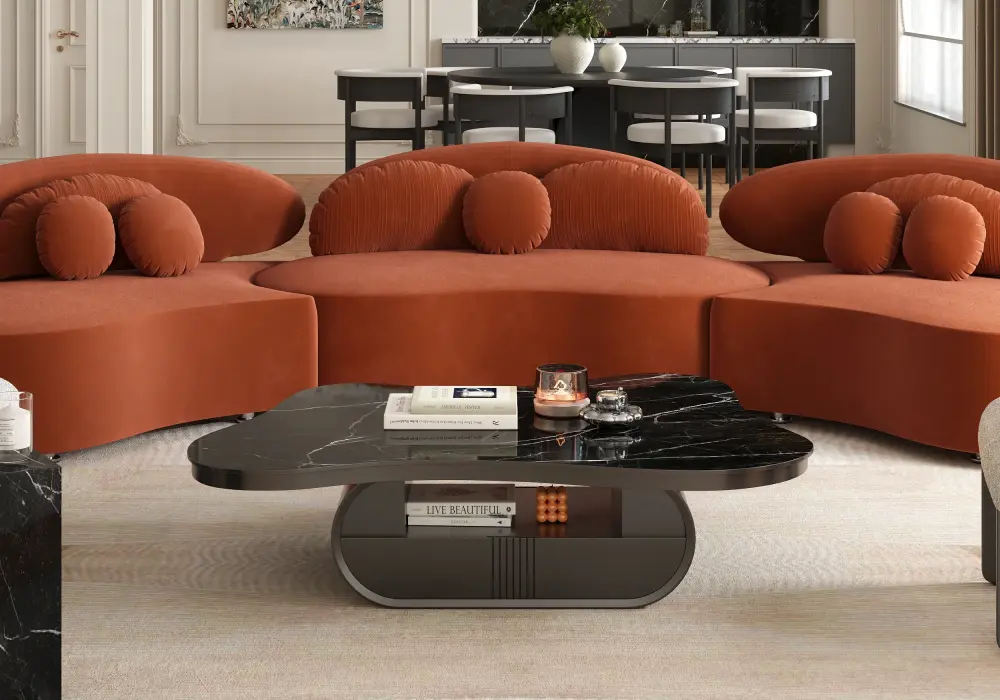
The 51" Oval Sintered Stone Coffee Table with Storage has a listed overall height of 14 inches. It can be considered alongside low seating when you want a low visual line. The listed 51-by-28-inch footprint also matters: a broad low table may still occupy considerable floor area.
A low table can work well for resting books or holding a tray within easy reach. It may be less convenient for someone who frequently sets down a drink from an upright position. Do not choose it only because the sofa is low; the person using the seat and the horizontal gap complete the decision.
A conventional format: 17 inches closed
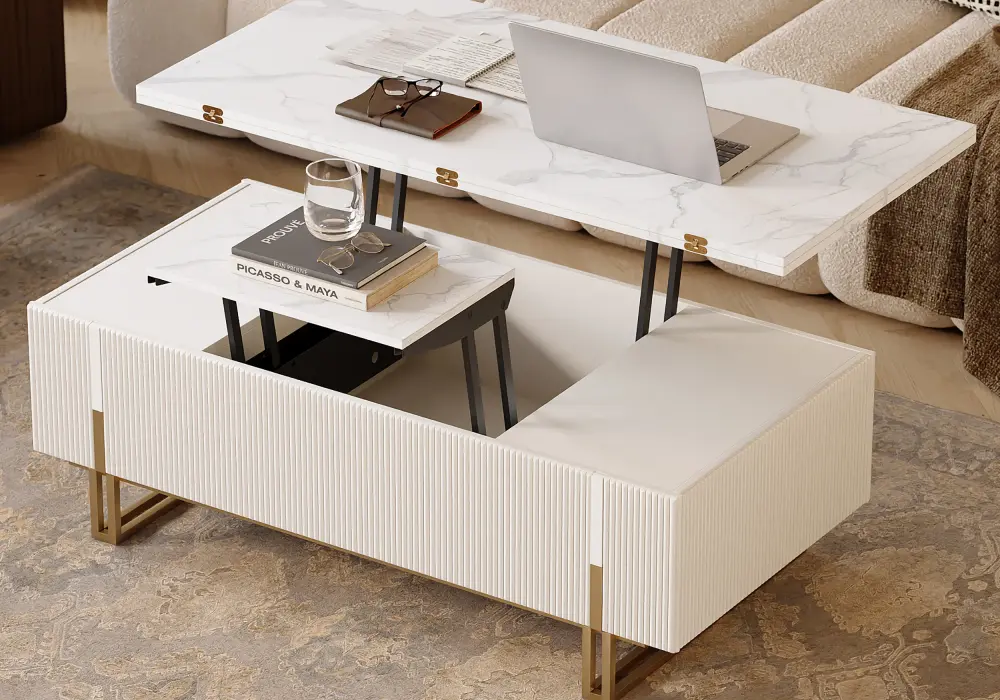
The Grovyn ivory fluted lift-top coffee table with two drawers is listed at 17 inches overall, with a 24-inch height when raised. Its closed position sits within the conventional coffee-table range, while the raised position needs a separate test for the intended activity.
A raised top can bring a surface closer, but the final position matters as much as the height. Sit with the laptop or meal where it would actually rest and check knee space, reach, and screen position. Check the direction of the lift and the room required around the top before placing it beside the sofa. A raised surface suits short tasks and meals; for a full workday, a proper desk gives better knee room and posture.
A taller format: 19 inches
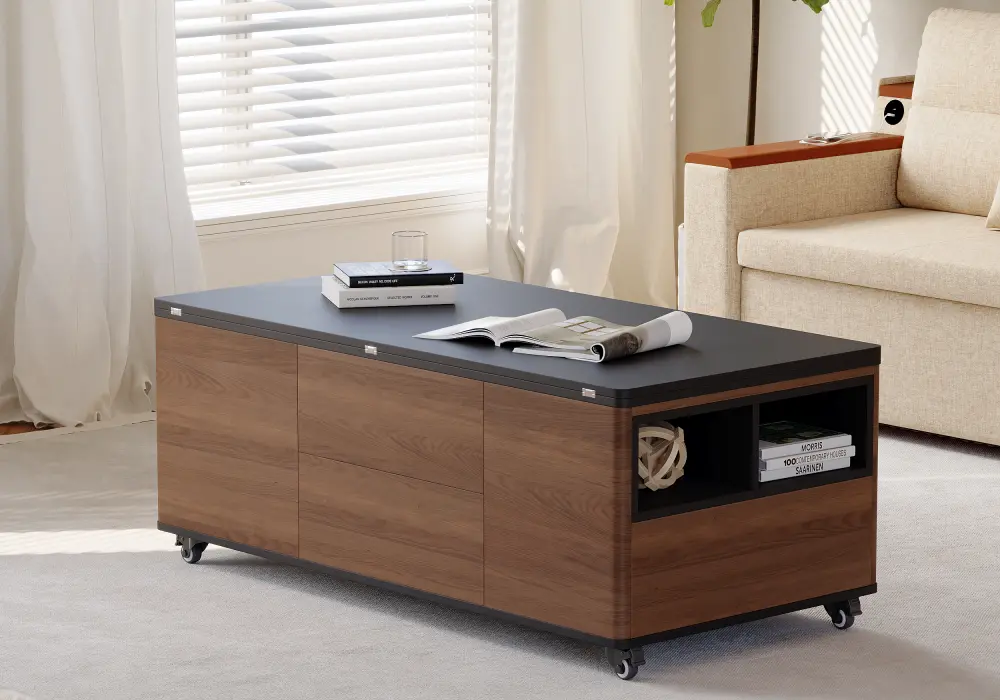
The 47-inch walnut-and-black lift-top coffee table with drawers and a cabinet lists a 19-inch overall height. That makes it a taller closed-position comparison than the other examples here. Its product description also identifies a lift-top function, so check its own raised-height diagram before planning work or dining around it.
A taller closed table may suit some seating arrangements but feel intrusive beside a deep, low sofa. Check how it relates to your knees when you turn toward the seat or stand up. Drawer handles, open drawers, and the table's base can affect that movement even when the top height seems suitable.
A five-minute test before you order
You do not need special tools to check a height. This routine catches most mismatches.
- Build a stand-in. Use sturdy boxes, a stool, or a bench to reach the candidate height, and confirm it with a tape measure from the floor.
- Sit the way you normally sit. If you usually lounge, lounge. Do not sit upright just for the test.
- Reach with an empty cup. Place it down and pick it up several times, and notice whether your shoulder or back changes position.
- Check knee clearance. Lean forward as if getting up and make sure nothing catches.
- Repeat from your most-used seats. Try the end seat, the middle, and, if you have one, the corner or chaise.
- Tape the footprint. Mark the full tabletop on the floor and walk your usual route through the room.
If the stand-in feels wrong, adjust the height or the gap by a small amount and test again, changing one variable at a time.
Check the footprint and walking space
Height does not solve an oversized footprint. Mark the complete tabletop and base on the floor, then walk the usual route through the room. Open the storage you expect to use, because drawers and doors need clear space in front of the table. A table that is comfortable from the sofa can still block a doorway or make it difficult to reach a console.
A heavy top or a low base can also make frequent repositioning impractical, so decide on a spot you will be happy with before ordering rather than counting on moving it later.
Common mistakes to avoid
- Matching numbers instead of comfort. Equal catalog heights do not guarantee equal reach.
- Ignoring the rug. A thick rug lifts the table relative to the sofa.
- Choosing by looks alone. A table that looks right from across the room may be awkward from the seat.
- Forgetting the gap. The right height at the wrong distance still feels awkward.
- Overlooking storage clearance. Drawers need room to open, and the table should not block your walking path.
- Assuming one test fits every seat. Sectionals and larger sofas need checks from several positions.
Frequently asked questions
Is 18 inches the correct height for every coffee table?
No. It falls within a common shopping range, but the sofa and the user determine whether it is comfortable. Compare it with the actual cushion height and test the reach. A low lounge arrangement or a taller seat may work better with a different table height.
Should a coffee table be higher or lower than the sofa seat?
A surface close to the seat height or slightly lower is a useful starting point, though not a universal rule. Sit normally and try the proposed height and gap together. Prioritize comfortable use over making the two catalog measurements match exactly.
Does overall height include the tabletop?
Yes. Overall height normally means the distance from the floor to the top of the assembled table. Leg height and under-table clearance are different dimensions. For a lift-top model, identify whether the listing refers to the closed position and find the raised measurement separately.
Can a lift-top coffee table replace a desk?
It can provide a useful surface for short tasks and meals. Check the raised height, reach, knee space, and your working posture first. For a full workday, a proper desk is the better setup.
How can I test coffee table height before ordering?
Create a stable temporary surface at the proposed height and sit in your normal position. Try reaching with an empty lightweight cup and standing up beside the mock-up. Repeat from the seats used most often before comparing against the final product dimensions.