

Choosing a coffee table sounds simple until you start comparing actual measurements. Most advice says a coffee table should be “the same height as your sofa seat or slightly lower,” but that leaves a lot unanswered. How many inches lower? What if your sofa cushions compress when you sit down? What if you have a chaise, an ottoman, or an unusually low sofa?
The most reliable starting point is simple: measure your sofa’s actual seat height, then choose a coffee table that is about 1–2 inches (2.5–5 cm) lower or roughly level with the seat. However, that rule needs adjustment for different seating styles and activities.
This guide explains exactly how to measure, calculate, and choose the right coffee table height before shopping or ordering a custom table.
Table of Contents
The Golden Rule — Coffee Table Height vs. Sofa Seat Height
For most living rooms, the sofa seat is the best reference point for choosing coffee table height. Instead of relying on a table’s advertised “standard” dimensions, start with the furniture you already own.
The basic formula
Ideal coffee table height = actual sofa seat height − 1 to 2 inches (2.5–5 cm)
For example, if your sofa seat measures 18 inches (46 cm) from the floor when you are actually sitting on it, a coffee table around 16–18 inches (41–46 cm) is usually a comfortable choice.
A table that is slightly lower than the sofa makes it easy to see across the room, reach for drinks, and rest your arms without creating an awkward visual or physical barrier.
That said, coffee tables come in several height ranges:
Coffee Table Type | Height | Best Matched With | Typical Use |
Low-profile | 12–14 in / 30–36 cm | Low modern sofas, platform sofas | Relaxed lounging, minimalist rooms |
Standard | 16–18 in / 41–46 cm | Most sofas and sectionals | Everyday living-room use |
High | 20+ in / 51+ cm | High-seat sofas, upright seating | Eating, working, easier access |
Low-profile tables: 12–14 in / 30–36 cm
A coffee table measuring 12–14 inches (30–36 cm) high works particularly well with low-slung contemporary sofas, modular seating, and platform-style furniture.
These tables are designed for rooms where people tend to lounge rather than sit upright. The lower profile can also preserve an unobstructed sightline between the sofa and television.
For rooms that need more flexibility, a nesting design can be useful. For example, Homary's round modern nesting coffee table with a sintered stone top and drawer uses two overlapping table surfaces, allowing you to adjust the usable footprint without committing to a taller single table. The built-in drawer also provides a practical place for remotes and other small items.
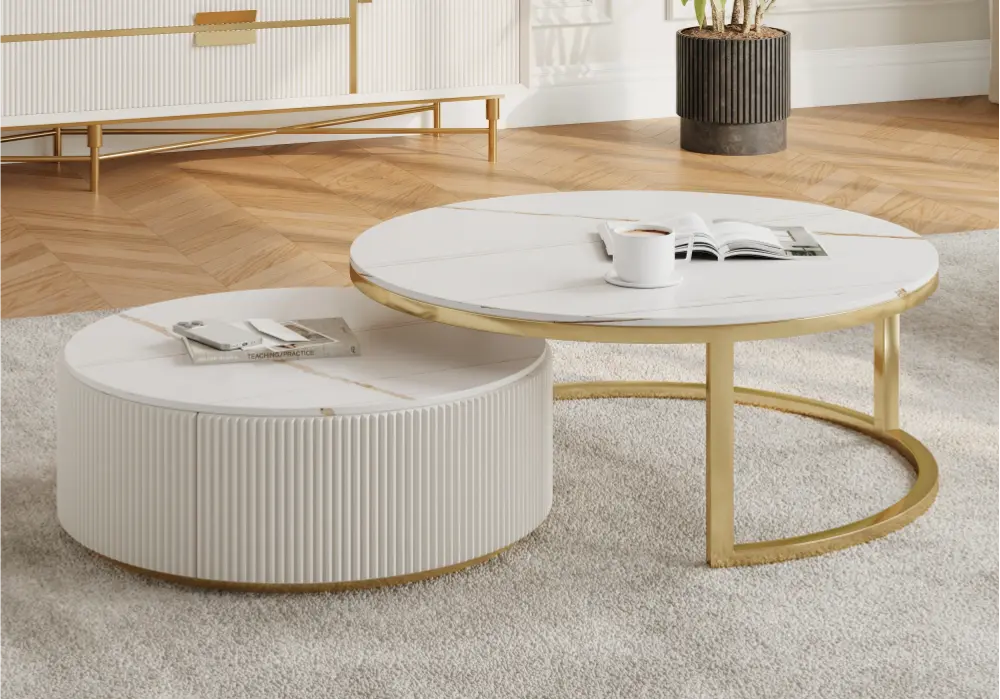
However, don't choose a 12-inch (30 cm) table simply because you like the minimalist look. If your sofa seat is 20 inches (51 cm) high, the difference may make everyday tasks such as reaching for a cup or placing down a laptop unnecessarily uncomfortable.
Standard tables: 16–18 in / 41–46 cm
For many living rooms, 16–18 inches (41–46 cm) is the practical middle ground.
This range commonly works with sofas whose actual sitting height is around 17–20 inches (43–51 cm). It provides enough clearance for comfortable leg movement while keeping the tabletop within easy reach.
A round nesting table can be especially helpful when your seating arrangement changes throughout the day. You can keep the smaller table tucked underneath for everyday use and pull it out when additional surface area is needed.
If you're buying a coffee table without knowing your exact preference, this is a useful starting range—but your sofa should still determine the final measurement.
High tables: 20+ in / 51+ cm
Coffee tables measuring 20 inches (51 cm) or more can be useful when the surrounding seating is unusually high.
They can also make sense when the table is expected to perform more like a casual dining or work surface. A higher tabletop is easier to reach from an upright seated position and can reduce the amount of bending required.
The important point is that “standard” does not mean “correct.” A coffee table should be proportional to the people and furniture using it, not simply conform to one universal number.
How to Measure Coffee Table Height Correctly — Step by Step
Getting the measurement right starts with measuring your sofa correctly. The biggest mistake is measuring the sofa frame rather than the surface where your body actually sits.
Step 1: Measure from the floor to the top of the seat cushion
Place a tape measure vertically from the floor to the highest usable point of the seat cushion.
Do not measure to the top of the sofa's back cushion. You only need the distance from the floor to the sitting surface.
Record the measurement in both inches and centimeters if possible.
Conversion formula:
- Inches × 2.54 = centimeters
- Centimeters ÷ 2.54 = inches
For example:
18 in × 2.54 = 45.72 cm
So an 18-inch seat is approximately 46 cm high.
Step 2: Measure while sitting on the sofa
This is the step many shoppers skip.
Sit on the sofa in your normal position and ask someone else to measure from the floor to the top of the compressed cushion near the area where your thighs rest.
Why does this matter? Upholstered cushions can compress significantly under body weight. A sofa advertised as having a 19-inch (48 cm) seat height may feel closer to 17–18 inches (43–46 cm) once you sit down.
For coffee-table sizing, the seated measurement is more useful than the empty measurement.
Step 3: Use your normal sitting posture
Don't sit unusually upright just for the measurement.
If you normally:
- lean back,
- put your feet flat on the floor,
- use a footrest,
- curl one leg underneath you, or
- lounge into the corner of a sectional,
measure in the position you actually use most often.
Your posture affects how easily you can reach the tabletop.
Step 4: Check foot and knee position
Place both feet naturally on the floor.
Your knees should remain comfortable, and the coffee table should not interfere with the space between your knees and the tabletop.
If the table is unusually tall, you may find yourself constantly hitting the underside with your knees. If it is extremely low, reaching down may become uncomfortable.
Step 5: Calculate your target height
Use this simple worksheet:
Measurement | Your Number |
Sofa seat height when empty | ____ in / ____ cm |
Sofa seat height while seated | ____ in / ____ cm |
Preferred table difference | −1 to −2 in / −2.5 to −5 cm |
Recommended coffee table height | ____ in / ____ cm |
For example:
Actual seated sofa height: 18 in / 46 cm
Target coffee table height: 16–18 in / 41–46 cm
If your sofa has very soft cushions, use the compressed measurement as your primary reference.
Beyond the Standard Sofa: Ottomans, Chaises, Platform Sofas & Low-Slung Seating
Not every living room revolves around a conventional sofa. Special seating arrangements require a slightly different approach.
Ottomans
An ottoman can replace a traditional coffee table, particularly when it has a firm, flat surface.
If you want to use an ottoman for drinks, books, or a tray, aim for a height close to the sofa seat—usually within about 1–2 inches (2.5–5 cm).
If the ottoman is primarily for putting your feet up, however, comfort may matter more than tabletop alignment. A softer, slightly lower ottoman can work better as a footrest.
A tray can also turn a soft ottoman into a more practical coffee-table surface.
Chaises and chaise sectionals
A chaise can complicate height selection because the user may be reclining rather than sitting upright.
For a sectional with a chaise, measure the primary seat height first. Then consider where the tabletop will actually be accessed. A table that is perfect for the upright portion of the sectional may feel too high when you're lying back on the chaise.
In this situation, a slightly lower table or a nested-table arrangement can provide more flexibility.
Platform and low-profile sofas
If your sofa seat is only 14–16 inches (36–41 cm) high, a conventional 18-inch (46 cm) coffee table may feel too tall.
Look for tables around 12–14 inches (30–36 cm) instead.
The visual relationship matters too: a tall table paired with a very low sofa can make the seating area feel top-heavy.
High sofas
If your sofa seat is over 20 inches (51 cm), consider a coffee table around 18–20 inches (46–51 cm), depending on how you use the space.
For a very upright sofa used for reading or conversation, a slightly higher tabletop may be more comfortable than automatically choosing a low coffee table.
When in doubt, make a temporary tabletop from a sturdy board or box at the proposed height and test it for a day.
Matching Height to How You Actually Use the Table — Eating, Working, TV, Kids & Pets
The “1–2 inches lower than the sofa” rule is a good starting point, but your activities should ultimately determine the final height.
Primary Use | Suggested Height | Why |
Everyday coffee table | 1–2 in / 2.5–5 cm below sofa seat | Easy reaching and balanced proportions |
Lounging/TV | 12–16 in / 30–41 cm | Keeps sightlines open |
Eating from sofa | 18–22 in / 46–56 cm | Easier to reach food and maintain posture |
Laptop work | 18–22 in / 46–56 cm | Better working height |
Tray-based serving | Close to sofa seat | Keeps cups and plates within reach |
Children's use | Lower, stable table with rounded edges | Easier access and reduced impact risk |
Eating on the sofa
If you regularly eat meals from your coffee table, a slightly higher design can be more practical.
A table around 18–22 inches (46–56 cm) can work well with upright seating, particularly when the tabletop is used for plates rather than simply drinks.
However, don't automatically turn your coffee table into a dining table. If your sofa is very low, raising the table too much can create an uncomfortable knee position.
Working on a laptop
Laptop work requires a different consideration because the keyboard and screen need to be reasonably accessible.
A coffee table around 18–22 inches (46–56 cm) may be more usable than a traditional 16-inch (41 cm) table, especially when you're sitting upright.
For occasional work, a lift-top design can be a particularly practical solution because it lets the tabletop move toward you rather than forcing you to change your sofa or sitting position.
For example, Homary's 39-inch lift-top coffee table with storage and four stools is designed to transition from a conventional coffee-table surface to a raised work or dining surface. Its hidden storage and movable stools also make it useful when a living room needs to serve several functions without adding a separate desk.
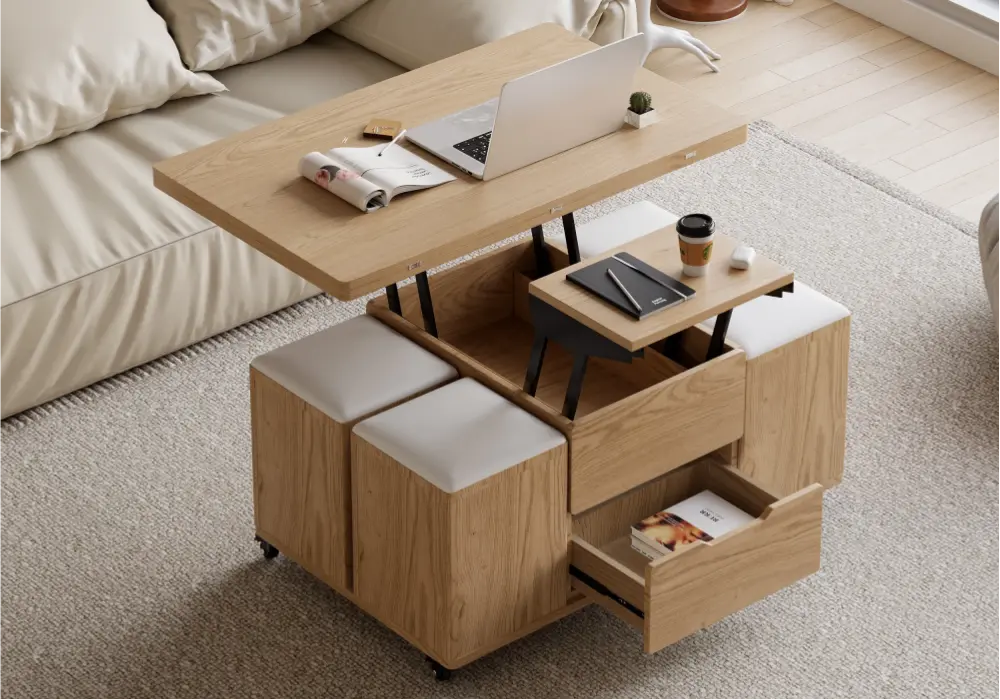
For extended work sessions, though, a properly designed desk is generally more ergonomic than a coffee table. A height-adjustable table can be useful if the same surface needs to support both lounging and occasional work.
Watching TV and using a tray
If the table is primarily for remote controls, drinks, books, and snacks, a lower table is usually sufficient.
A tray can make a low table much more versatile. Instead of increasing the entire table height, you can bring frequently used items closer to hand with a raised serving surface.
Children and pets
If children frequently use the living room, stability may be more important than achieving an exact height.
Look for:
- Rounded or softened corners
- A stable, wide base
- No easily tipped pedestal
- Smooth edges
- Sufficient clearance for legs and feet
- No small detachable parts that can become hazards
For pets, avoid designs that create tight spaces where collars, paws, or toys can become trapped. A sturdy table with predictable clearance is usually preferable to an overly complicated base.
Accessibility considerations
Accessibility should be treated as a general design principle rather than an afterthought.
A person using a wheelchair or experiencing limited mobility may need more knee and leg clearance than a standard coffee table provides. A table with a broad central base or low horizontal shelf can sometimes interfere with forward approach.
Consider:
- Enough knee clearance beneath the tabletop
- An easy-to-reach tabletop
- Rounded or low-impact edges
- A stable base that does not obstruct feet
- Adequate clearance for mobility equipment
For accessibility-focused rooms, prioritize clear approach space and ease of reach over a strict sofa-to-table height formula.
Storage Clearance & Adjustable Tables — When Height Needs to Flex
Storage can change how a coffee table's height works. A tabletop may be the perfect height, but a low shelf underneath can become inconvenient if it leaves too little room for books, baskets, feet, or cleaning.
As a practical starting point, allow approximately 4–6 inches (10–15 cm) of useful clearance between a lower shelf and the floor, depending on what you intend to store. For drawers or compartments, measure the actual interior opening rather than judging the exterior height.
Adjustable coffee tables are useful when one surface has several jobs.
Use | Approximate Height |
Low lounging | 12–16 in / 30–41 cm |
Standard coffee-table use | 16–18 in / 41–46 cm |
Casual eating | 18–22 in / 46–56 cm |
Laptop/working surface | 20–28 in / 51–71 cm |
These ranges are starting points, not universal rules. An adjustable table should be tested at each intended height before you commit to it.
For example, a 47-inch oval walnut lift-top coffee table combines an adjustable lift-top with hidden storage, making it useful when the same table needs to work as a low coffee table during everyday lounging and a raised surface for working or dining. The storage compartment also helps keep frequently used living-room items out of sight without requiring a separate storage unit.
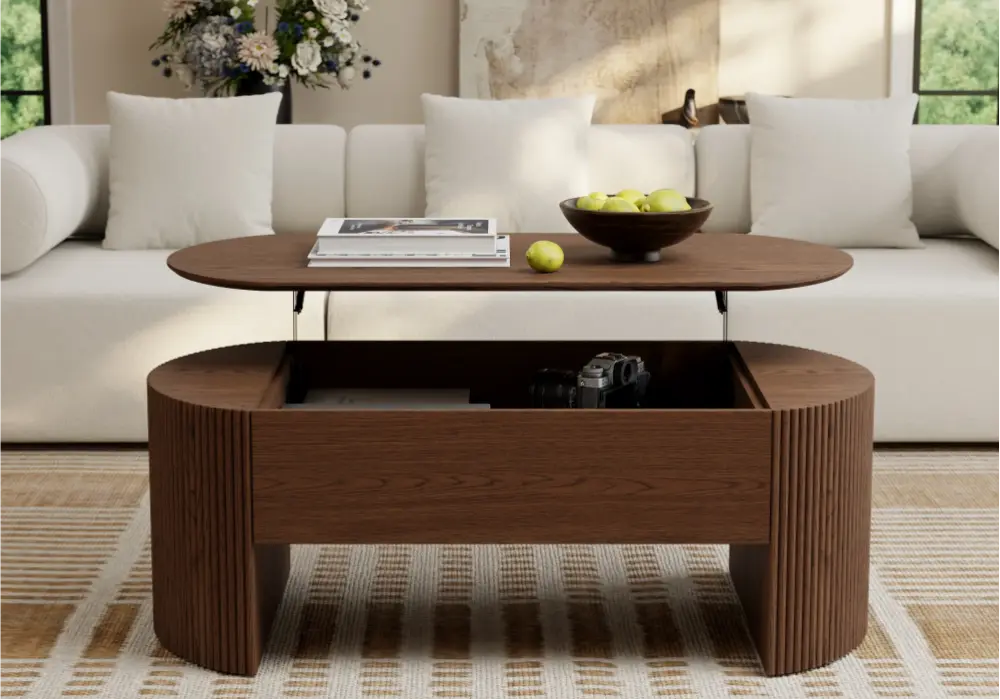
This kind of flexible design is particularly useful when a living room has to accommodate several activities. Instead of choosing one height that is merely “good enough” for everything, the table can adapt to the task.
The table's shape, finish, and relationship to the rug are important for the room's appearance, but height should remain the first measurement you solve.
FAQ
What is the standard coffee table height in inches and centimeters?
A typical coffee table is around 16–18 inches (41–46 cm) high. However, there is no single height that works for every sofa. Low-profile tables may be 12–14 inches (30–36 cm), while higher tables can be 20 inches (51 cm) or more.
How does coffee table height relate to sofa seat height—is there a simple formula?
Yes. Start with:
Coffee table height = actual sofa seat height − 1 to 2 inches (2.5–5 cm)
A table approximately level with the sofa seat can also work, especially when the tabletop needs to be used frequently for eating or working.
How do I measure the right coffee table height at home, accounting for cushion compression?
Measure from the floor to the top of the seat cushion while sitting normally on the sofa. If possible, have another person take the measurement. This accounts for cushion compression and gives you a more realistic “working” seat height than measuring an empty sofa.
Can an ottoman replace a coffee table, and what height works best?
Yes. A firm ottoman can function as a coffee table, especially when paired with a tray. If it is primarily used as a surface, aim for approximately 1–2 inches (2.5–5 cm) below the sofa seat or close to seat height. If it is mainly a footrest, comfort can take priority over exact alignment.
What coffee table height is best for eating, working on a laptop, or using a tray?
For everyday use, 16–18 inches (41–46 cm) is a good starting range. For eating or occasional laptop work, 18–22 inches (46–56 cm) may be more practical, depending on the sofa and your posture. For tray use, staying close to sofa-seat height usually provides the easiest reach.
What accessibility guidelines should I follow when choosing a coffee table height?
Focus on reach, knee clearance, stable construction, and unobstructed approach space. A person using a wheelchair or with limited mobility may need more clearance beneath the table than a conventional coffee table provides. Avoid bases or shelves that interfere with the user's feet or mobility equipment, and consider rounded edges for safer circulation.