

You can extend a kitchen island in four main ways: use an existing pull-out or folding mechanism, add a purpose-designed folding leaf, have a countertop or cabinet extension professionally designed, or use a separate worktable for occasional extra space. The right option depends on what you need the extra surface for, how much room is available, and whether the existing island can safely support the change.
Before choosing a method, measure the island in its closed and fully extended positions, including the space needed while the extension moves. Consider how you will use the additional surface, whether it needs to accommodate seating, and what will support it under the intended load.
This guide compares the main extension options, explains the measurements to check, and shows how to plan for everyday use without compromising kitchen access.
Table of Contents
Choose the Right Kitchen Island Extension
Start by deciding what the extra surface needs to do. A solution that works for occasional serving may not be suitable for everyday food preparation or dining.
Extension method | Best suited for | What to check | Main consideration |
Existing pull-out or folding mechanism | Occasional serving, dining, or additional workspace | Operating instructions, extended dimensions, and built-in supports | Must be used as designed |
Purpose-designed folding leaf | Additional surface that can be folded away when not needed | Folding movement, securing mechanism, and support requirements | Needs space to open and close |
Professionally designed countertop or cabinet extension | More permanent preparation or serving space | Island construction, materials, load support, and installation requirements | May require structural modifications |
Separate worktable or cart | Flexible supplementary workspace | Stability, working height, storage position, and circulation | Does not permanently enlarge the island |
If you need more surface area for occasional meals, an integrated extension may be enough. If you need a larger preparation area every day, a professionally assessed countertop or cabinet alteration may be more appropriate. If the kitchen is already crowded, a separate worktable that can be moved out of the way may be the more practical choice.
Decide How You Will Use the Extra Surface
The intended use should guide the dimensions, height, materials, and support requirements.
For food preparation: Consider the usable work area, surface material, access to drawers, and the distance to frequently used appliances. A larger surface is helpful only if it does not make normal preparation and cleanup more difficult.
For serving: An occasional-use extension may provide enough space for dishes and serving platters. Check whether it can be opened without moving other furniture or blocking access to the refrigerator.
For casual dining: Plan for the table height, knee space, seating position, and clearance behind occupied chairs. The size of the extended surface alone does not determine how many people can sit comfortably.
For extra storage and workspace: Look for a layout that provides the right combination of drawers, cabinets, and surface area. A separate cabinet or a differently configured island may be more effective than extending the countertop alone.
These distinctions also help narrow down ready-made products. For example, the Modern 73"-93" Extendable White & Black Kitchen Island with Dining Table, Seats 4 is listed with a pull-out table and storage. It is a design to investigate if you want an integrated extension rather than a separate table.
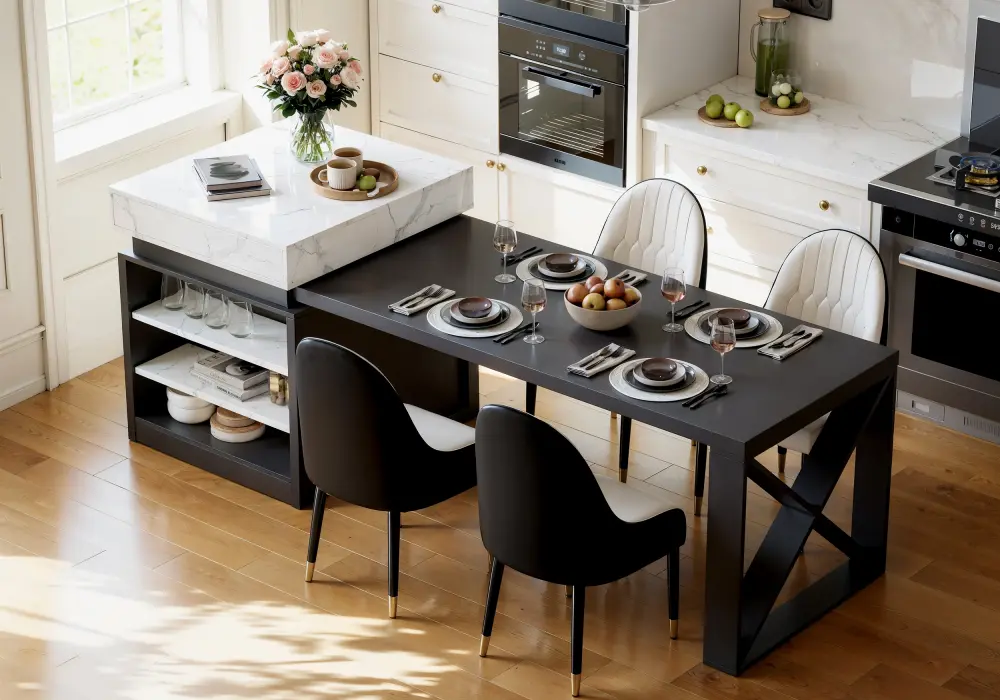
Measure the Closed, Moving, and Open Positions
A kitchen island extension needs to fit in more than one position. Measuring only the existing island or the final extended length can overlook the space needed to operate the mechanism.
Measure the existing island
Record the island's length, width, and height. Note nearby cabinets, walls, appliances, doors, and furniture. Identify any drawers or doors that need to open during normal use.
Confirm the fully extended dimensions
Use the manufacturer's dimension drawing, not just the product title, to establish the island's full length and width when open.
If the extension moves sideways, rotates, or unfolds toward the kitchen's main walkway, mark the complete area it occupies. Do not assume that the additional surface extends in the direction suggested by the product photograph.
Account for the opening movement
Mark the area swept by the extension as it opens and closes. A design may fit when fully extended but collide with a chair, cabinet, or appliance during movement.
Check the kitchen routes
Walk through the kitchen as you would during a typical meal. Check access to the refrigerator, sink, oven, dishwasher, drawers, and adjacent rooms.
Distinguish between a working aisle where people prepare food and a general passage used to move through the kitchen. NKBA's publicly available kitchen planning guidelines give starting work-aisle benchmarks of 42 inches for one cook and 48 inches for multiple cooks.
Include seating and daily activities
If the extension is used for dining, mark the chair positions and allow for people to sit down, stand up, and move behind occupied chairs. If it is used for preparation, confirm that the open surface does not prevent access to essential appliances or storage.
A useful planning sketch should show three things: the closed footprint, the full extended footprint, and the movement required between them.
If Your Island Already Has a Pull-Out or Folding Extension
An existing extension is usually the first option to investigate because the island may already have the components needed for the intended use.
Obtain the instructions for the exact model. Confirm what moves, where the mechanism should be operated, whether a support must be positioned, and how the extension is secured.
A pull-out table, folding leaf, and rotating extension can have different operating sequences. Prepare the surrounding space as directed, remove anything that could interfere with the movement, and follow the specified sequence until the extension reaches its intended supported position.
Do not force a mechanism that binds or fails to align. Stop using it if it cannot be secured as intended, and request assistance from the manufacturer or a qualified service professional.
When evaluating a ready-made pull-out design, look beyond its appearance. Check the open footprint, the usable surface area, the support arrangement, and whether the extension can be operated without moving nearby furniture.
Consider a Folding Leaf or Permanent Countertop Extension
If the existing island does not have a suitable mechanism, the next step is to decide whether a folding addition or a more permanent alteration is appropriate.
Folding leaf
A purpose-designed folding leaf may provide additional surface area when needed and return to a smaller footprint when closed.
Before choosing this option, establish where the leaf rests when folded, how it opens, and what supports it in use. Legs or brackets may occupy space needed for seating or standing, and the folding motion may require more clearance than the final open position suggests.
Use a design with instructions and support components suited to the intended application. Do not assume that a generic hinge or improvised bracket will safely support a heavy or frequently used extension.
Permanent countertop or cabinet extension
A fixed extension may be more appropriate when you need extra preparation space every day. However, enlarging the countertop changes the loads and demands placed on the existing structure.
Have a qualified installer or appropriate design professional assess how the new surface will be supported. Depending on the island's construction, this may involve existing cabinetry, additional cabinets, legs, brackets, or another engineered arrangement.
The correct solution depends on the actual materials, dimensions, construction, and intended load. There is no universal overhang measurement or bracket specification that is suitable for every island.
Also consider the joint between the original and added surfaces, edge alignment, cleaning access, and the finished height. A continuous-looking countertop may require additional design work to achieve a practical and well-supported result.
Do not drill into, cut, or attach a heavy surface to freestanding furniture based solely on a product photograph. Check the manufacturer's restrictions and seek professional assessment before modifying the structure.
Compare Storage and Extended Dimensions Before Choosing a New Island
Sometimes, extending an existing island is not the best solution. A purpose-designed extendable island may provide a better combination of additional surface area, storage, and everyday functionality.
However, comparing only the advertised length can be misleading. Check the closed dimensions, fully extended dimensions, table movement, storage configuration, and intended use together.
A practical comparison should answer these questions:
- How much floor space does the island occupy when closed and open?
- Does the extension move toward a wall, a cabinet, or the main walkway?
- Are the drawers and cabinet doors accessible in both positions?
- Does the additional surface have a specified support arrangement?
- Is the surface intended for dining, serving, preparation, or another use?
If storage is the main priority, compare the number and layout of storage compartments as well as the extension mechanism. An island that provides more surface area but makes everyday storage less accessible may not improve the kitchen overall.
Choose the Surface for Preparation, Dining, or Serving
The surface material and finish should suit the way the extension will be used.
For food preparation, follow the material manufacturer's guidance on cleaning, cutting boards, heat protection, and food contact. Do not assume that a marble-pattern or faux-marble description means the surface is made from solid marble or another particular stone.
If a product has a faux-marble top, for example, confirm its actual construction and care requirements rather than relying on the appearance shown in photographs.
For dining, establish the table height, knee space, and seating arrangement before choosing a finish. A surface may look suitable in a product photograph but still be uncomfortable for everyday meals if the extension, supports, or surrounding cabinets interfere with seating.
Do not add a sink, cooktop, or other built-in equipment to a furniture extension unless the design and manufacturer explicitly support that application. Appliance installation introduces additional structural, utility, and safety requirements beyond those of an ordinary work or dining surface.
Consider a Separate Worktable or Mobile Kitchen Island
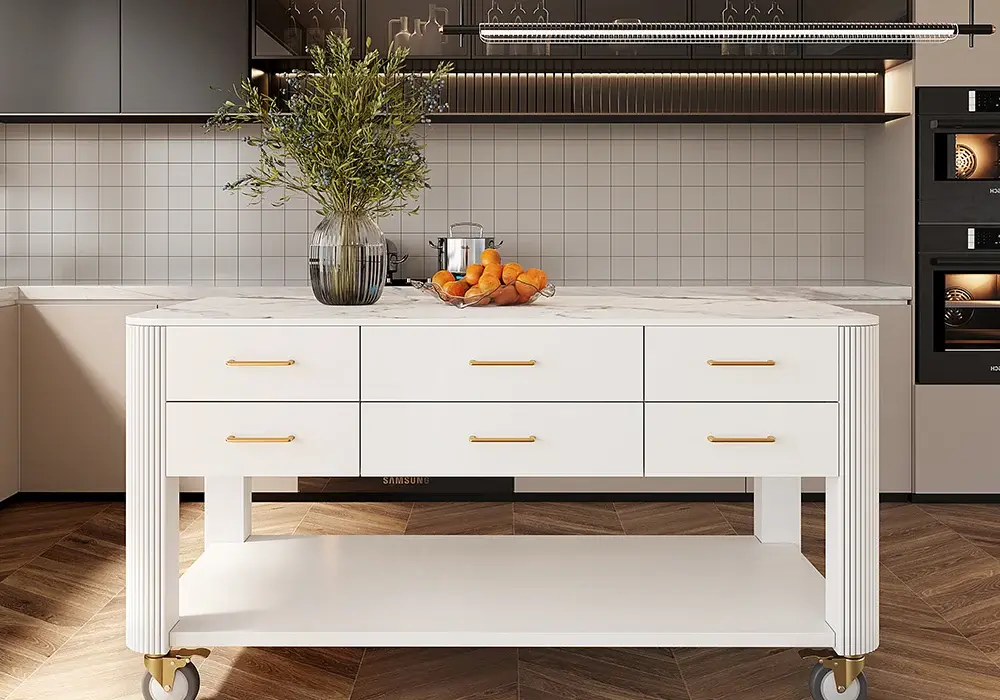
If your kitchen needs more workspace but you don't want to modify the existing island, a separate worktable or mobile kitchen island can be a practical alternative. It provides an additional surface for meal preparation, serving, or setting out dishes when entertaining, while allowing you to keep the original layout unchanged.
For kitchens that also need extra storage, Homary’s Modern 60" Wood Kitchen Island with Wheels & Cabinets combines a work surface with drawers, cabinets, and open shelving. Its mobile design offers more flexibility than a fixed extension, particularly when you want to reposition the island as your needs change.
Before choosing a mobile island, measure the available space and consider where it will be stored when not in use. Check its dimensions, stability, and wheel-locking features, and make sure it won't obstruct walkways, appliance doors, or access to nearby cabinets.
Test the Layout Before Finalizing Your Choice
Use painter's tape to mark the proposed closed and open footprints on the floor. Add temporary furniture or cardboard to represent the extension's approximate dimensions.
Then simulate a typical meal. Prepare food, open drawers, place dishes on the surface, pull out chairs, and walk between the main kitchen areas.
Pay attention to anything that requires someone to move repeatedly. An extension that adds useful surface area but interrupts access to the refrigerator may make the kitchen less convenient.
Check the closing process as well. Determine whether the surface needs to be cleared before moving, whether chairs need to be relocated, and whether the mechanism and supports can be accessed without shifting other furniture.
Choose the option that works for both ordinary daily use and occasional larger meals. The goal is not simply to increase the countertop outline, but to create a more useful kitchen.
Frequently Asked Questions
Can I Extend an Existing Kitchen Island Without Replacing It?
Possibly. The right method depends on the island's construction, intended use, and modification restrictions. An existing pull-out or folding mechanism should be operated according to its instructions. A permanent countertop alteration needs an assessment of the structure and proposed support. A separate worktable is another option when modification is unsuitable.
How Do I Open a Pull-Out Kitchen Island Table?
Follow the instructions for the exact product, including the specified movement, support, and securing steps. There is no universal operating sequence for every design. Do not force a mechanism that binds or fails to align.
How Much Space Do I Need to Extend a Kitchen Island?
Measure the existing island, the fully extended dimensions, and the area swept by the extension while it opens. Then check appliance access, working aisles, general passages, and occupied seating positions. The required space depends on the specific design and the way the kitchen is used.
Can I Add a Larger Countertop Overhang for Seating?
Have the proposed overhang and support assessed for the actual materials and island structure. Also check dining height, knee space, chair positions, and circulation. Adding surface length alone does not establish that the extension is adequately supported or comfortable for seating.
Does an Extendable Kitchen Island Save Space?
It can reduce the everyday footprint compared with keeping the same surface permanently open, provided that the design and room accommodate both positions. The opening motion and fully extended arrangement must still work without obstructing essential kitchen routes.
Can I Use an Island Extension for a Cooktop?
Do not assume that a furniture extension can support a built-in appliance. Confirm manufacturer compatibility and obtain appropriate installation design for the structure, utilities, and appliance requirements. A surface intended for serving or dining is not automatically suitable for a cooktop.