

A round coffee table looks finished when it has a small focal group and an obvious place to set a drink. Leave part of the circle open, vary the height of the objects, and keep the display clear of any lifting or rotating top.
The useful starting point for how to style a round coffee table is the seat beside it. Place a cup where you naturally reach, then arrange the decoration elsewhere. That practical landing area gives the composition its boundaries and prevents an attractive display from taking over the whole surface.
Table of Contents
Work with the circle instead of filling its center
A circle has no corners to hold separate groups, so several scattered accessories can make the whole top feel occupied. Gather the main pieces in one area and leave an open arc facing the seating. An arrangement slightly off-center often feels more relaxed than placing every object on the table's exact midpoint.
Choose an anchor that suits the scale of the surface. A shallow tray, one book, or a bowl can organize the display. A rectangular book provides contrast to the circular top. A round tray repeats its shape for a softer effect.
Test the anchor before adding objects. If it prevents a second person from setting down a glass, reduce its size or use it without a tray. The grouping should make the table easier to read, not create a new obstacle. For a sofa with a chaise, approach the table from both sitting positions. An open area facing only the main sofa may leave the chaise seat reaching over a vase. Move the focal group until the people using the table have a clear route to its surface.
Create height with one object, then keep the rest quiet
Use a small upright object to give the arrangement some lift. A vase or plant can do this, but its full outline should stay below important sightlines. Check from the sofa if the table sits between the seating and the television. Foliage spreads beyond the pot, so the container alone does not tell you how much space the piece takes.
Pair the upright object with something lower. A book lying flat or a shallow bowl creates a change in level without needing several decorative pieces. Let one object have the strongest shape or color and allow the others to support it.
The familiar rule of three can help if the objects have different roles, but it is optional. Two well-scaled pieces may be enough on a small round top. A stack of books already counts as a visual group. Adding several more accessories can quickly crowd the remaining space.
Use the same seated test for practical items. Keep the remote where it is easy to find, or put it in accessible storage, rather than hiding it under a display that must be dismantled each evening.
Give nesting tables different jobs
Homary's Nesnesis round lift-top nesting coffee tables combine white and natural finishes with two storage drawers. The two surfaces allow the styling to be divided by use: a modest focal group on one, with the other available for a drink or snack. Their contrast already contributes color, so they do not need matching displays.
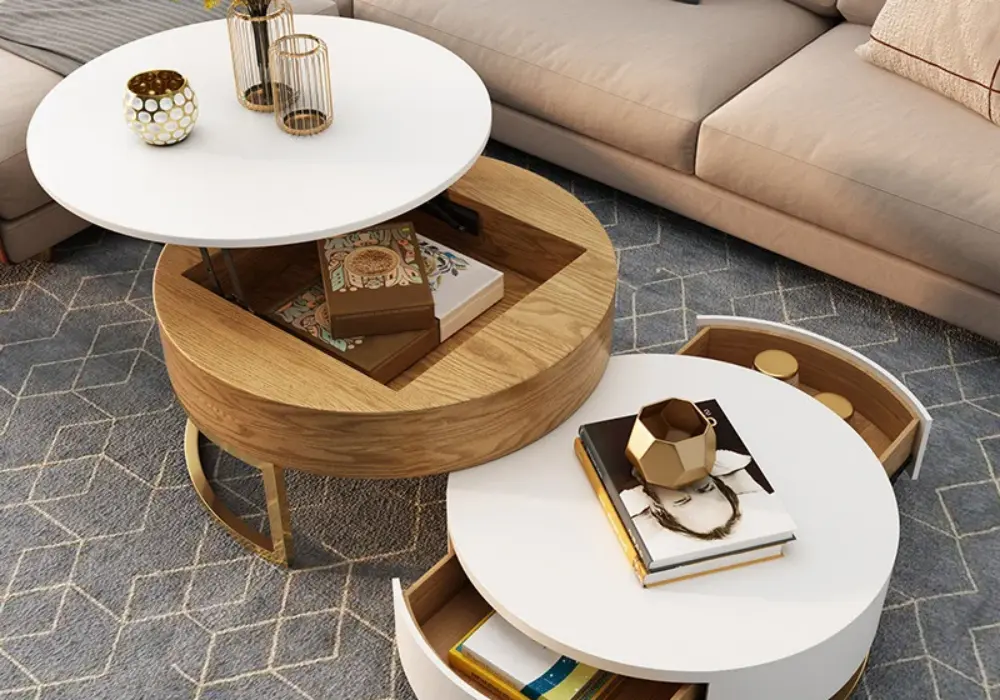
Begin with the tables in the arrangement used most often. Put the objects on them, then test any change of position that forms part of your routine. Keep fingers and decorative items away from the moving parts, and follow the product's instructions when operating the lift.
If the smaller table is moved beside a chair, a coaster may be all it needs. Repeating a full decorative group there can make it harder to use and give the room two competing focal points. A single shared accent color can connect the surfaces without duplicating the objects.
Keep the drawer approach clear so you can retrieve everyday items from the usual seat. That leaves storage useful when the tables are arranged closely together.
Let the finish guide color and texture
Look for a connection to the living room rather than an exact match to the sofa. A warm ceramic tone can relate to wood furniture; a dark book cover can repeat a metal detail elsewhere. On a pale top, darker objects create definition, while a natural-toned surface may look calmer with a lighter vessel.
Keep competing patterns to a minimum. If the rug is busy, let the table accessories be simpler. If the room is mostly plain, a book cover or small patterned bowl can introduce a little character without changing the furniture. A mix of smooth and textured surfaces often provides enough interest without another color.
Choose pieces you are willing to handle. A delicate object on a frequently used table may need moving every time someone puts down a snack. A vase needs a stable base and suitable protection beneath it. Follow the furniture's care guidance and keep water from pooling on the top.
Keep moving tops easy to use
The natural rotating-tray coffee table has a top that swivels to reveal hidden storage. It measures 23.6 inches in diameter and 15.75 inches high (60 cm by 40 cm). That compact surface makes a restrained arrangement sensible: a low object with a clear place for a cup, rather than a broad tray covering most of the top.
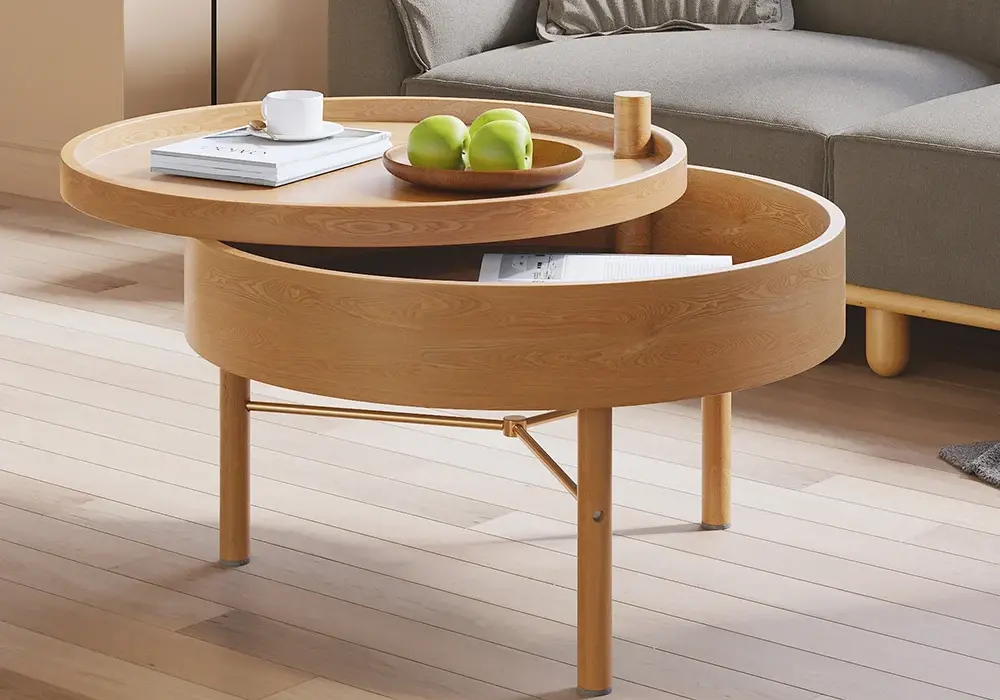
Place decor where it can be removed easily before you access storage or operate the top. Do not assume that an unsecured vase or book stack can travel safely with a moving surface. Leave the area needed for the mechanism clear and use it as directed.
If a work surface is the larger priority, Homary's walnut-and-white lift-top coffee table is an alternative. It is a rectangular design rather than a round table, and its description supports dining or laptop use alongside storage. Keep everyday decoration easy to clear when the top changes function. Arrange the objects for its rectangular surface rather than copying a circular layout.
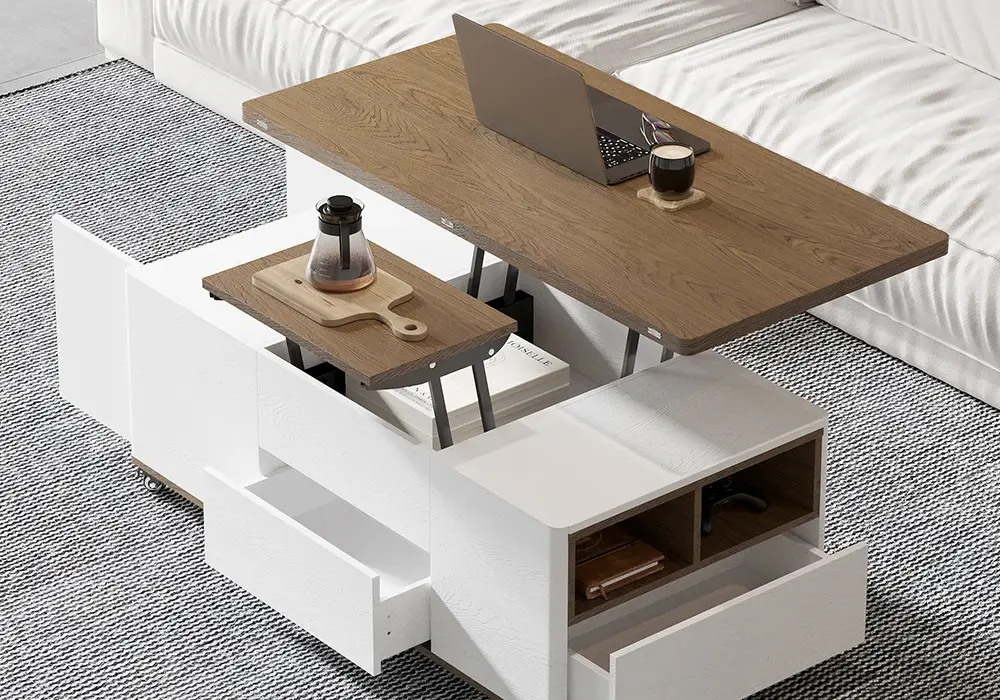
Use the hidden space for loose everyday items so the visible surface can stay simpler. If reaching it requires several trips to remove decorations, reduce the display.
Finish with a quick everyday-use test
Sit in each nearby seat and set down a drink. Pick up the remote. If the furniture has a moving top, clear and operate it following its instructions. The arrangement passes when those ordinary actions are straightforward.
For a fresh start, use this short sequence:
- Remove everything and choose the most useful drink landing area.
- Add one anchor in another part of the circle.
- Place one taller object and one lower companion, if space allows.
- Remove any piece that blocks reach, sightlines, or storage access.
Live with that smaller setting before adding more. Changing a book or a few stems can refresh the table without rebuilding it. The goal when deciding how to style a round coffee table is a surface that looks considered and is ready to use. Start with the linked round Homary designs, then adapt the display to their actual functions.
Frequently Asked Questions
Can I use a square tray on a round coffee table?
Yes. The contrast can give a loose group of objects a clear boundary. Keep the tray fully inside the tabletop edge and leave enough space around it for drinks and hands. On a small circle, a large square tray may consume too much of the surface, so test it before adding decorative pieces.
How many books should go on a coffee table?
Use only as many as the arrangement and surface can comfortably hold. One large book can act as an anchor; a short stable stack can create a raised platform. Avoid a stack that makes the table harder to clear or puts a vessel at an awkward height. Keep books away from wet coasters or spilling drinks.
How do I style a round table beside a curved sofa?
Keep the curve visible by leaving the tabletop's edges relatively open. A small grouping can repeat the softness of the seating, while a rectangular book adds contrast. Reach matters more than symmetry: test from the sofa's ends as well as the center so the display does not block the only convenient landing area.
Should I decorate the lower shelf or hidden storage too?
An open shelf can hold a neat group of books or a basket if the fit works, but hidden storage does not need decoration. Use it to keep the visible surface manageable. Avoid stuffing either space so tightly that objects interfere with a moving top or make ordinary items difficult to retrieve.