

A standard TV stand does not have one universal width or height. The right media console fits the television's actual support footprint, places the screen at a comfortable height, and gives your equipment somewhere practical to live. Start with those measurements before choosing a finish or drawer layout.
The size printed on a TV box is its screen diagonal, not the width of the cabinet it needs. A console advertised for a particular screen size is a starting point for shopping, not proof of compatibility. Two televisions with the same diagonal can need different amounts of supporting space.
Table of Contents
Measure the television before the furniture
Find the TV's dimensions with its supplied stand attached. Record the full width and depth of the support base, including the outermost edges of separate feet. Compare that footprint with the usable top of the console, rather than only its overall length. Every foot should sit completely on the intended supporting surface. Keep the screen diagonal separate from the television's outer width, which includes its frame. Foot spacing is another measurement again. It helps determine the supporting width, while the feet's depth must fit front to back.
For visual balance, try a console that extends beyond the sides of the screen. As an optional styling starting point, leaving about 3–6 inches (8–15 cm) on each side gives the TV a broader base. That margin is an aesthetic choice, not a load rating or a substitute for the manufacturer's support instructions. A wall-mounted screen can also look balanced above a wider console, even though the furniture carries no TV weight.
Suppose a television measures 57 inches (145 cm) across and you prefer 4 inches (10 cm) of visible furniture on either side. The resulting visual target is about 65 inches (165 cm). That is a hypothetical calculation, not a specification for every 65-inch television. It still needs a separate check for foot depth and the console's permitted load.
Choose height from your seated view
A useful height target is to place the screen's center near your natural seated eye level. Samsung's living-room mounting advice starts with measuring eye level from the viewer's usual seat. Apply that seated check to furniture-supported televisions too, instead of selecting the console height in isolation.
Sit where you normally watch. Measure from the floor to your eyes, then use the TV's setup dimensions to work out where the center of the screen would land on a candidate console. For example, if eye level is 40 inches (102 cm) and the screen center is 18 inches (46 cm) above the supporting surface, a console around 22 inches (56 cm) high puts those points near one another. These are example measurements; your sofa and TV may produce a different result.
A taller cabinet may suit viewing from dining chairs or a bedroom arrangement, while a low sofa often changes the preferred height. A reclined position changes the viewing angle as well. Try the screen outline at the proposed height on the wall and look from the seats that actually get used. With a wall-mounted TV, choose the viewing height first, then consider the furniture beneath it.
Make depth and storage work for your equipment
Depth is easy to overlook when searching for a standard TV stand. A long console can still be too shallow for the TV's feet or for a receiver with cables attached. Measure equipment with its connectors in place and include the ventilation space specified in each device's manual.
Separate the items that need daily access from the ones that only need storage. A controller or spare cable can go in a drawer. Powered equipment needs a suitable location for airflow and access to connections. An attractive closed drawer is not automatically an appropriate operating compartment for electronics.
Homary's Fero extendable TV stand has three deep drawers with soft-close runners and a listed length range of 47–71 inches (119–180 cm). That combination illustrates how an adjustable console can provide a place for loose accessories while letting the furniture's length suit the wall.
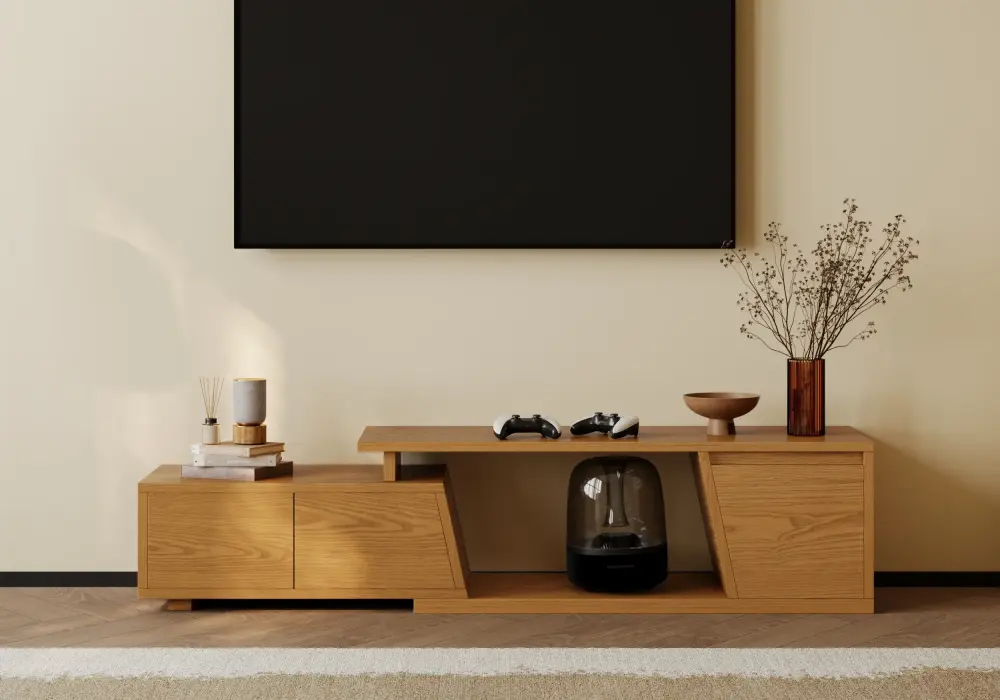
Leave room to open those drawers without moving the coffee table. If a console sits opposite an ottoman, map the drawer fronts in their open position as well as the furniture's closed footprint. Storage that cannot be reached comfortably tends to push small items back onto the top.
Understand what an extendable stand changes
Extension adjusts the arrangement and overall length of a media console. It does not, by itself, establish a continuous load-bearing surface across every position. Check the exact configuration approved to support a television, along with the current depth and load limit, before placing the screen on an extended design.
The Quoint extendable TV stand offers a 71–100-inch range (180–254 cm), three drawers, and cabinets that can be positioned on the left or right. That left-or-right arrangement matters when a doorway, an outlet, or another piece of furniture determines which end of the wall is easier to use. Try the layout around the room's fixed features rather than automatically extending it to its maximum length.
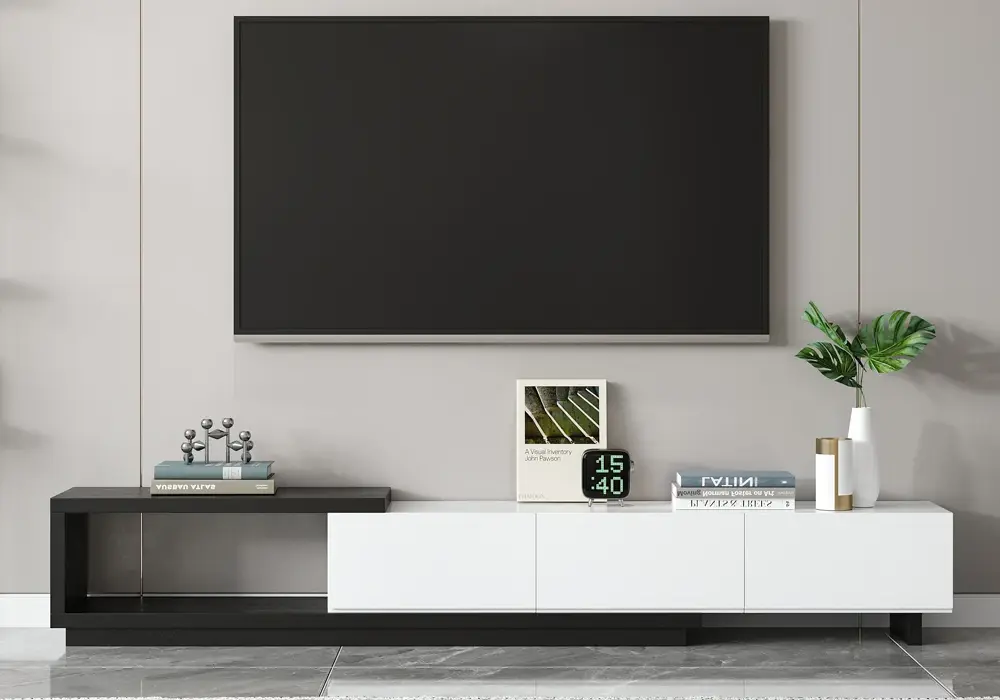
Homary's extendable floor TV stand with three drawers is another option for changing the console's span. Its official room image shows a low, dark arrangement beneath a mounted screen. The low silhouette can give a broad TV wall a quieter base.
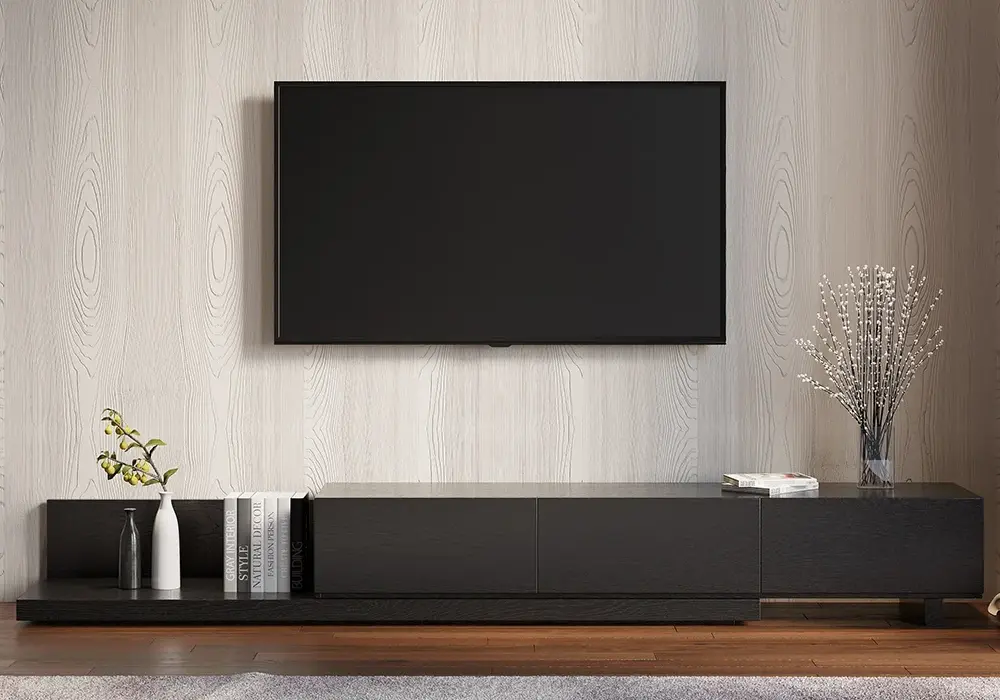
An extended section also needs a job. It might create room for a speaker or a small lamp, subject to the furniture's instructions and the device's clearance needs. Extra length is less useful if it narrows the route to a door or leaves the center of the screen awkwardly positioned relative to the sofa.
Check the setup before committing to a size
Use a tape outline of the console on the floor and a screen outline on the wall. Look at them from the sofa, then walk through the room. A size that works on an empty wall may crowd the route beside a chair or interfere with curtains. Include the gap needed for rear connections rather than pressing furniture against the wall simply to gain a little floor space.
Keep these checks together:
- The TV's complete support footprint fits the usable top.
- The furniture's permitted load covers the intended setup.
- The screen height feels comfortable from the usual seats.
- Equipment has the required airflow and cable space.
- Doors, drawers, and the room's walking route remain usable.
Follow the TV and furniture instructions for assembly and any specified anchoring or tip-over protection. Keep heavy objects in their intended positions and avoid arranging tempting items where children might climb to reach them.
Use those measurements to compare the linked Homary media consoles. The extension arrangement should work around the room, and the storage should suit the equipment you use.
Frequently Asked Questions
Does a TV stand have to be wider than the television?
A wider console often gives the screen a more balanced visual base, but appearance and support are different checks. For a furniture-supported television, the complete base or feet must fit on the approved supporting surface and the load must be within the furniture's limit. A mounted TV allows more freedom in console width.
Can a wall-mounted TV use a lower media console?
Yes. When the screen is mounted, its viewing height can be set independently of the console. Choose the furniture for equipment storage and its relationship to the wall. Leave the clearance required by the screen, mount, and any devices, and avoid raising the TV merely to make room for tall decorations.
Should the soundbar sit in front of the TV?
It can, if the space and device instructions allow it. Check that it does not block the lower screen, the television's receiver for remote signals, or ventilation openings. Measure the soundbar's depth and any required clearance rather than assuming an empty strip at the front of the console is sufficient.
Is a long console a poor choice for a small room?
Not necessarily. A low console along an unobstructed wall may use the room well, but its depth and drawer access still matter. Measure the walking route and compare its visual weight with the sofa. A shorter cabinet is preferable when extra length would crowd a doorway or force an awkward screen position.