

A rug does not have to go under a TV stand. In many living rooms, it works better beneath the seating group and stops before the console, leaving a visible strip of flooring. Extending it under TV stands and media consoles can also work when the rug is large enough and the furniture remains stable. The decision depends on the room’s proportions, the cabinet’s support points, and how you use the surrounding floor.
Treat this as a layout choice, not a rule about matching furniture. The rug should help organize the room without making the console uneven, obstructing access, or creating an awkward edge across a walking route.
Table of Contents
Decide what area the rug is defining
Most living-room rugs visually gather the sofa, chairs, and coffee table into one seating area. The television wall can remain outside that area and still feel connected through color, material, and alignment. A gap between the rug and the console is therefore perfectly reasonable.
In another room, a large rug may cover almost the entire furniture arrangement. If it reaches the television wall naturally, the console can sit on it, provided the support and clearance requirements are satisfied. The goal is a coherent room, not stopping at a predetermined furniture boundary.
Begin by looking at the room from the entrance. Does the rug define a usable seating group, or does it look like a small island beneath the coffee table? Adjusting the rug in relation to the sofa may improve the room more than moving it closer to the TV stand.
Compare the three main arrangements
Rug arrangement | When it can work | What needs checking |
Stops before the console | The rug defines the seating group | The exposed floor looks intentional and the edge is outside the main route |
Fully under the console | A large rug unifies most of the room | All required supports rest evenly and doors or drawers work |
Partially under the console | A specific layout requires overlap | No support is left at a different height or perched on a bound edge |
The third arrangement deserves particular care. A console that spans a rug edge can have some supports on the pile and others on the floor. Depending on the support design and rug thickness, that can make the furniture rock, twist, or sit out of level.
Do not correct an unstable arrangement by improvising under one leg. Reposition the rug or furniture and follow the cabinet’s leveling instructions. The console’s stability matters more than whether the rug reaches a preferred visual line.
Check the base before choosing the rug position
A cabinet with individual legs meets the floor differently from one with a broad plinth or several separate base sections. Look at all the actual contact points. A long cabinet can have supports near the center that are easy to miss when planning from a front photograph.
For an extendable console, consider the final configuration. Moving a section outward may place a support beyond the rug or onto its edge. Set the furniture’s width first, then check the complete support arrangement. Do not assume that a rug position suitable for the compact setup will work after extension.
If a TV rests on the cabinet, follow the TV and furniture instructions for support and securing. A rug does not provide stability or replace anchoring where required. Confirm that the furniture is level and that all intended support points bear properly before adding equipment.
Use measurements instead of a universal gap rule
There is no single compulsory distance between a rug edge and a TV stand. The visible strip of floor can be narrow or generous depending on the room, console depth, and placement of the seating group. What matters is that it reads as deliberate and remains practical.
Mark possible rug outlines with removable tape. Check the relationship to the sofa, coffee table, doorways, and console. If you are deciding between two rug sizes, test both outlines before buying. A size that looks right beside the console may still leave chairs awkwardly positioned elsewhere.
For a simple comparison, imagine a rug ending just before a console’s front supports. Moving it slightly could leave those supports partly on the binding. Moving it farther back might create a clear gap instead. The second change can improve both stability and appearance without requiring a new rug.
Match the rug to different console designs
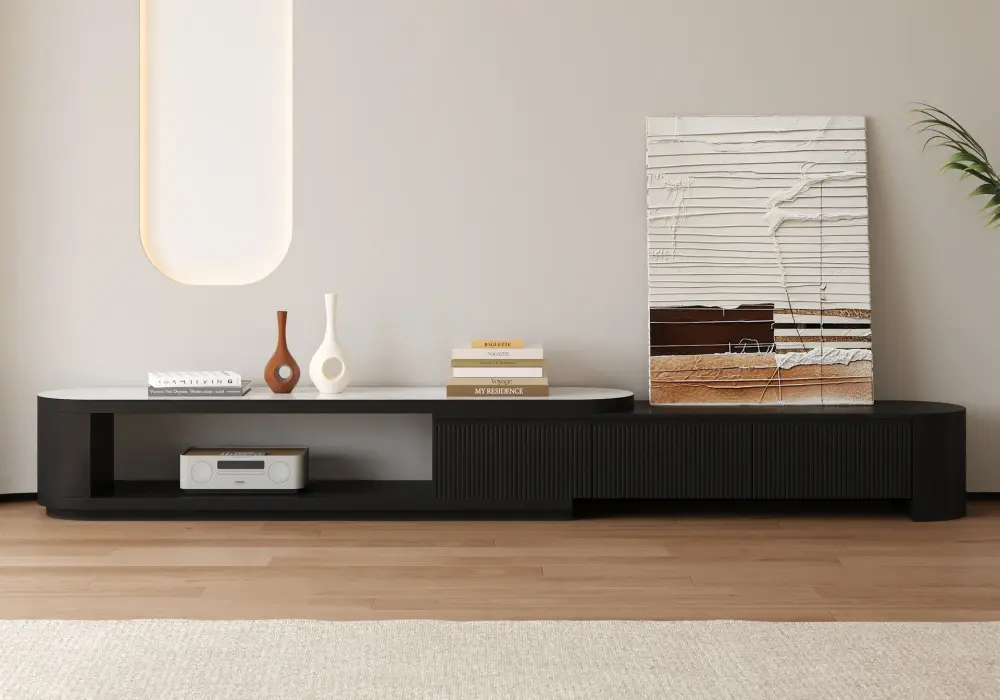
Homary’s Velar 71"–114" Sintered Stone Top Extendable TV Stand has an extendable format and three drawers. Its rounded, fluted design can remain a focal point with exposed flooring beneath it. If you prefer a rug overlap, check support placement across the full chosen extension.
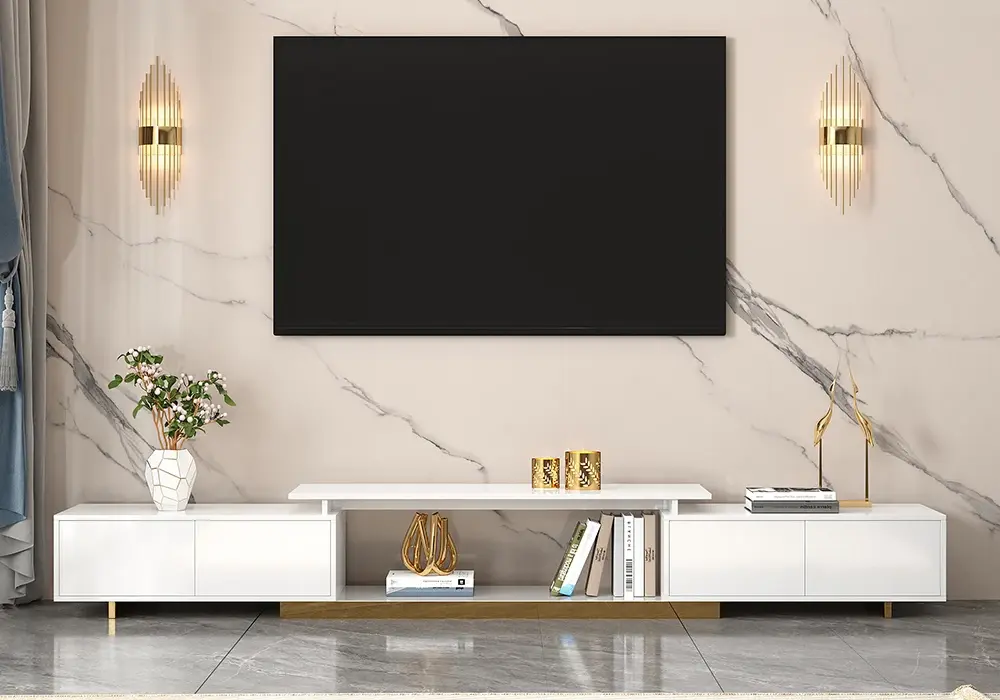
The Mordel 63"–94" Extendable Hidden Storage TV Stand is listed with hidden storage and an adjustable width from 63 to 94 inches. Establish that width before deciding how far the rug should reach. A rug arrangement should accommodate the furniture’s working configuration rather than its shortest product photograph.
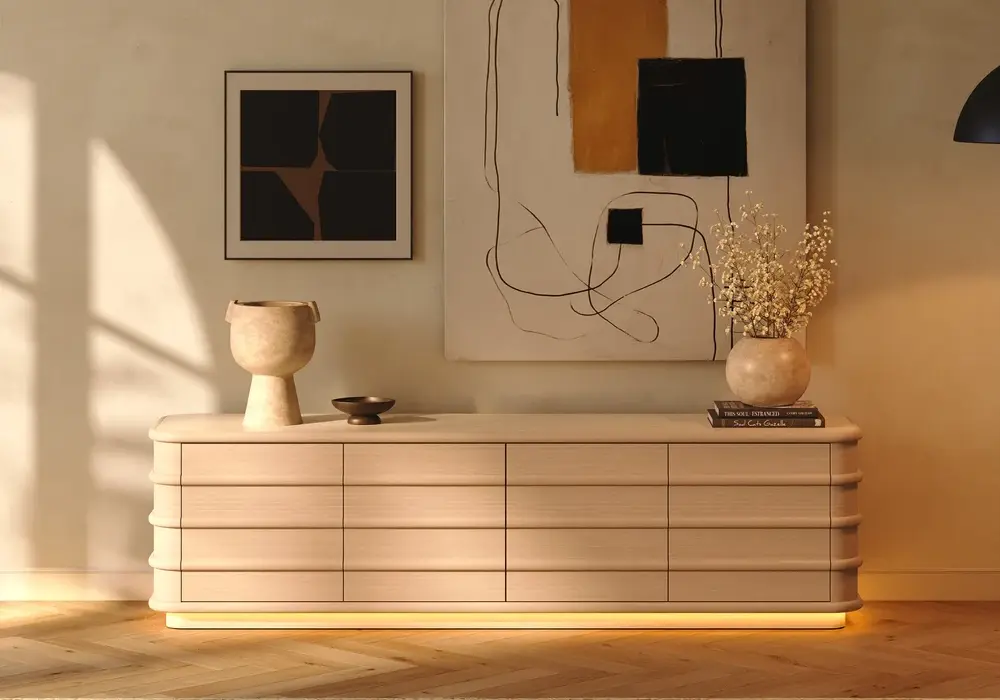
The Larvo 80" Ash Wood TV Stand provides a fixed-width alternative with built-in dimmable lighting. Test rug color under the lighting you actually use. A textured rug and a wood cabinet can sit together comfortably without sharing the same exact tone.
These examples illustrate different planning needs. None requires a particular rug placement merely because of its style. The decisive details are the support structure, selected position, and relationship to the rest of the room.
Consider pile, pads, and everyday access
A thick pile and thick pad can change how a console sits. They may also affect clearance beneath low doors or drawers if the rug extends into their travel. Check those movements after positioning, rather than assuming a closed cabinet photograph proves adequate space.
Use a pad appropriate to the rug and floor, following the relevant care instructions. Avoid building up several layers to make one support reach the same height as another. If the furniture is unstable, change the arrangement instead of treating the rug system as a leveling device.
Think about cleaning, too. A rug trapped beneath a long, heavy console can be harder to rotate or remove. If you expect frequent cleaning or seasonal rearrangement, leaving the console on the hard floor may be more convenient. Check that vacuum access remains practical around the cabinet and cables.
Keep cable routes independent of the rug decision
Do not extend a rug simply to hide electrical cords. Plan equipment wiring through appropriate routes and follow the device instructions. A loose lead concealed under a rug can be damaged or become difficult to inspect, and the rug edge may still create a trip point.
If the console includes lighting, allow for its cable as well as television and audio equipment. Recheck the route when adjusting an extendable section. Furniture movement should not pull the connection tight or trap a cable beneath a support.
Finish the layout by testing the room as you use it: walk from the entrance, sit down, open the console storage, and clean around the rug edge. Choose the arrangement that stays level, gives the seating group a clear shape, and works without constant adjustment.
Frequently Asked Questions
Is it wrong to leave the TV stand off the rug?
No. Keeping the television wall on exposed flooring is a common practical arrangement. The rug can define the seating area while the console remains connected through the room’s overall palette and furniture placement.
Can only the front legs sit on the rug?
Check the furniture’s stability rather than following that rule automatically. If front and rear supports end up at different heights, the console may not sit properly. A clear gap or full, even support can be a better arrangement.
Should the rug be wider than the TV stand?
Not necessarily. Choose the rug primarily for the area it defines and the furniture it supports. A rug beneath the seating group does not have to match the console’s width, particularly when the television wall sits outside it.
Is a low-pile rug better beneath a console?
A lower pile may simplify positioning and clearance, but it does not guarantee stability. Check the pad, rug edge, floor, and every support point. The furniture should remain level in its final configuration.
What if my rug almost reaches the TV stand?
Avoid leaving a support perched on the binding. Move the rug to create a deliberate gap or a stable overlap, then reassess the seating arrangement. A small positional change can be more useful than forcing the edge beneath the cabinet.